
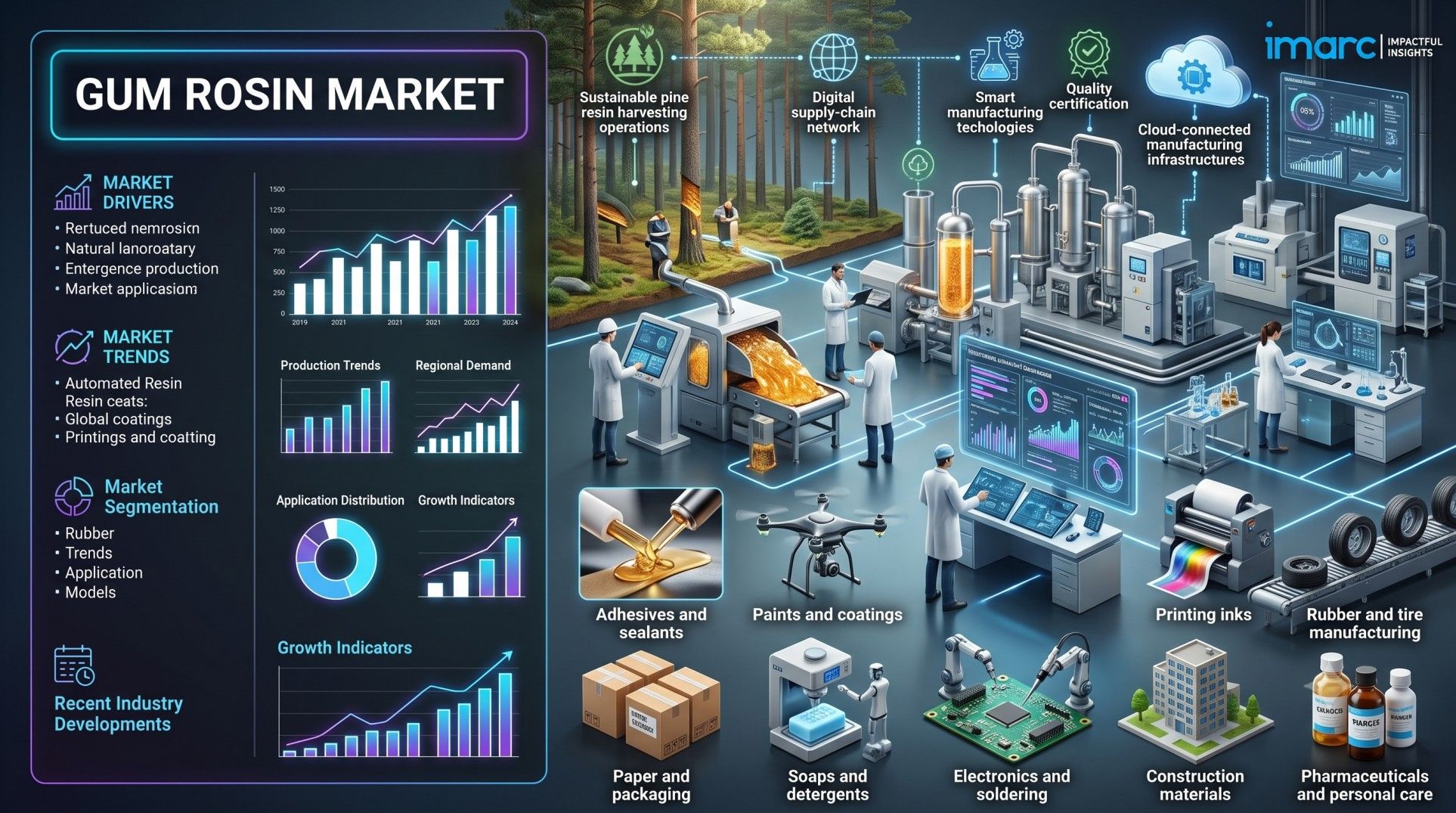
IMARC Group, a leading global market research and management consulting firm, has published its latest market intelligence report on the gum rosin market. The global gum rosin market size reached USD 1.64 Billion in 2025. Looking forward, IMARC Group expects the market to reach USD 2.39 Billion by 2034, exhibiting a growth rate (CAGR) of 4.26% during 2026-2034, driven by the growing global emphasis on sustainability and environmental responsibility, expanding applications of gum rosin across diverse industries, and continuous advancements in extraction and purification processes that are improving both yield quality and cost efficiency for manufacturers worldwide.
The market is experiencing steady growth momentum driven by the increasing alignment between industrial demand for natural, renewable raw materials and the practical performance advantages that gum rosin offers across adhesives, coatings, rubber, and paper applications. Manufacturers across construction, automotive, and packaging are seeking bio-based inputs that deliver strong adhesion and film-forming performance while supporting corporate sustainability commitments, a need that gum rosin is uniquely positioned to meet given its natural origin from pine oleoresin. The expansion of the cosmetics and personal care sector, spanning lipsticks, creams, and haircare formulations, is reinforcing this demand by relying on gum rosin derivatives for tackiness and film formation. Simultaneously, advances in tapping, distillation, and purification technologies are improving supply consistency and product purity, enabling manufacturers to serve increasingly quality-sensitive downstream industries.
How AI is Reshaping the Future of the Gum Rosin Market
- AI-Powered Yield Forecasting and Tapping Season Planning for Pine Resin Producers: Machine learning platforms are enabling forestry cooperatives and resin processors to analyze weather patterns, tree health data, and historical tapping yields to optimize harvest scheduling and improve oleoresin collection efficiency, reducing supply volatility and helping gum rosin manufacturers in China, India, Brazil, and Indonesia plan production runs with greater confidence heading into each tapping season.
- Intelligent Quality Grading and Automated Purity Testing in Processing Facilities: AI-driven analytical systems integrated into gum rosin distillation and grading lines are automating the classification of output into WW, WG, X, N, M, and K grades based on color, softening point, and acid value at a speed and consistency that manual grading cannot match, reducing batch rejection rates and ensuring compliance with quality specifications demanded by adhesive, coating, and pharmaceutical customers.
- Supply Chain Traceability and Sustainability Verification Using Data Analytics: AI-powered traceability platforms are enabling gum rosin buyers and brand owners to verify the geographic origin, sustainable sourcing practices, and carbon footprint of raw material shipments, shortening supplier qualification cycles and giving manufacturers in adhesives and personal care greater confidence in meeting environmental, social, and governance reporting requirements before committing to long-term supply contracts.
Grab a sample copy of this report: https://www.imarcgroup.com/gum-rosin-market/requestsample
Gum Rosin Market Trends and Drivers:
The global gum rosin market is witnessing steady expansion, fueled by the convergence of sustainability-driven procurement, structural growth in adhesive and rubber applications, and tightening regulatory frameworks that are reinforcing demand for natural, bio-based raw materials over synthetic alternatives. Sustainability considerations sit at the center of this shift, with regulatory bodies across multiple countries imposing stricter environmental compliance requirements that are encouraging manufacturers to move away from petroleum-derived resins and toward gum rosin-based formulations. In China, the world's largest gum rosin producing region, industry bodies have developed national standards, including a dedicated method for calculating carbon storage in pine oleoresin and a carbon footprint evaluation guideline for gum rosin and gum turpentine, giving processors a formal framework to document the sustainability credentials that downstream adhesive and coatings buyers increasingly require. In India, chir pine forests across Jammu and Kashmir, Himachal Pradesh, Garhwal, and Kumaun remain regulated under state-level resin and forest produce trade legislation, with government-authorized depots overseeing the purchase and sale of tapped resin, a structure that continues to shape supply consistency and pricing for the domestic rosin and turpentine industry.
The expanding application base of gum rosin across rubber manufacturing, construction, and automotive components is reinforcing market growth. Rising global vehicle production is catalyzing demand for high-performance rubber components such as tires, hoses, gaskets, and conveyor belts, where gum rosin enhances tackiness and overall product performance. Gum rosin is also gaining traction as a concrete additive that improves workability and reduces cracking in construction mixtures, a use case benefiting from the continued expansion of infrastructure development across Asia Pacific and the Middle East. Regional price data illustrates the tightness in supply and demand dynamics shaping the market: in September 2025, gum rosin prices in the United States reached approximately USD 1,283 per metric ton on firm downstream demand from adhesive and packaging manufacturers, while prices in Germany climbed to roughly USD 1,553 per metric ton over the same period on strong regional demand.
Continuous technological advancement and product innovation are further strengthening the market outlook. Manufacturers are investing in research and development to enhance the solubility, compatibility, and performance characteristics of modified gum rosin products, broadening their appeal across adhesives, inks, varnishes, and pharmaceutical coating applications. Strategic industry partnerships are also emerging around sustainable sourcing, with adhesive and polymer companies jointly developing frameworks that link renewable energy use and reduced carbon footprints to specific rosin-based product lines, reflecting a broader industry shift toward measurable, verifiable sustainability performance rather than general environmental claims.
Gum Rosin Industry Segmentation:
The report has segmented the market into the following categories:
Breakup By Grade:
- WW
- WG
- X
- N
- M
- K
WW accounts for the majority of the market share. It forms strong and durable bonds, making it a valuable ingredient in the formulation of adhesives used across packaging, woodworking, and automotive industries. It also exhibits excellent solubility in various solvents, which enhances its usability across a wide range of formulations. Products containing WW grade gum rosin, such as paints and coatings, further demonstrate strong long-term durability and resistance to environmental factors, extending the lifespan of finished products.
Breakup By Application:
- Paper Sizing
- Printing Ink
- Adhesives and Sealants
- Rubber
- Paints and Coatings
- Others
Adhesives and sealants hold the largest application share. They are versatile products with extensive use across construction, automotive, and packaging industries. Gum rosin exhibits strong chemical compatibility with various additives used in adhesive and sealant formulations, allowing manufacturers to customize products to specific performance requirements. Ongoing research and development efforts continue to improve gum rosin-based adhesive and sealant performance, reinforcing its role as a preferred bonding ingredient across industrial applications.
Breakup By Region:
- North America (United States, Canada)
- Europe (Germany, France, United Kingdom, Italy, Spain, Others)
- Asia Pacific (China, Japan, India, South Korea, Australia, Indonesia, Others)
- Latin America (Brazil, Mexico, Others)
- Middle East and Africa
North America leads the market, accounting for the largest gum rosin market share. The region benefits from a well-established infrastructure for logging and extracting pine resin, ensuring a consistent and reliable source of raw material for manufacturers. Several producers are adopting advanced extraction and processing technologies that are improving production efficiency and output quality. The southern United States in particular possesses extensive pine forests rich in resin sources, while the region's diverse industrial base across adhesives, paints and coatings, inks, and rubber continues to drive steady demand for gum rosin.
Competitive Landscape:
Companies are strategically expanding their market presence by entering new regions and establishing a broader global footprint through distribution partnerships and local business acquisitions. Many are also collaborating with downstream users and research institutions to explore new applications and develop customized formulations. Leading players continue to invest in research and development activities focused on enhancing gum rosin quality, exploring new application areas, and developing innovative, higher-purity product formulations.
The report provides a comprehensive analysis of the competitive landscape in the gum rosin market with detailed profiles of all major companies, including:
- Deqing Jiyuan Synthetic Resin Co. Ltd.
- Forestar Chemical Co. Ltd.
- Foreverest Resources Ltd.
- Grupo Resinas Brasil
- Guilin Songquan Forest Chemical Co. Ltd.
- Jinggu Forestry Chemical Industry Co. Ltd.
- KH Chemicals BV
- Perum Perhutani
- PT. Naval Overseas
- Resin Chemicals Co. Ltd.
- Silver Fern Chemical Inc.
- United Resins - Produção de Resinas S.A.
- Wuzhou Sun Shine Taiping Forestry and Chemicals Co. Ltd.
What Does The Full Report Cover?
If you are tracking the gum rosin market for investment decisions, market entry planning, competitive benchmarking, or strategic advisory, IMARC Group's report gives you everything in one place:
- Complete market sizing with detailed segment-level revenue breakdowns
- Quantified growth driver analysis with impact scoring across grade, application, and regional markets
- Sub-segment breakdowns for WW, WG, X, N, M, K grades and paper sizing, printing ink, adhesives and sealants, rubber, paints and coatings applications with individual share data
- Country-level data for the United States, Canada, Germany, France, the United Kingdom, Italy, Spain, China, Japan, India, South Korea, Australia, Indonesia, Brazil, and Mexico
- Competitive profiles of leading companies with strategic landscape assessment
- Porter's Five Forces, value chain analysis, and pricing intelligence
- Latest sustainability and regulatory trends covering bio-based sourcing standards, carbon footprint evaluation frameworks, and supply chain traceability developments shaping market competition across key regional markets
Recent News and Developments in Gum Rosin Market
- April 2025: Henkel and Synthomer announced a strategic partnership and supply agreement focused on cutting carbon emissions in Henkel's TECHNOMELT hot melt adhesive portfolio across European, Indian, Middle Eastern, and African markets, building on Synthomer's CLIMA-branded rosin-based product line that delivers a meaningful reduction in cradle-to-gate product carbon footprint through renewable energy use in production.
- September 2025: Gum rosin prices across major producing and consuming regions moved higher, with United States prices reaching approximately USD 1,283 per metric ton and Germany reaching roughly USD 1,553 per metric ton, driven by firm downstream demand from adhesive and packaging manufacturers alongside constrained feedstock availability from limited tapping activity.
- January 2026: Regional gum rosin pricing data showed China gum rosin trading at approximately USD 1,549 per metric ton FOB, India at USD 1,657 per metric ton CIF, and the United States at USD 1,634 per metric ton FOB, reflecting continued firm demand from adhesives, coatings, and paper sizing industries entering the new year.
Note: If you require specific details, data, or insights that are not currently included in the scope of this report, we are happy to accommodate your request. As part of our customization service, we will gather and provide the additional information you need, tailored to your specific requirements. Please let us know your exact needs, and we will ensure the report is updated accordingly to meet your expectations.
Key Questions This Report Answers
- What is the current global gum rosin market size?
- Which grade segment holds the largest share in the global gum rosin market?
- What are the key drivers of global gum rosin market growth?
- Which region dominates the global gum rosin market and why?
- How are sustainability regulations and carbon footprint reporting standards reshaping sourcing decisions across the gum rosin supply chain?
- Who are the top companies in the global gum rosin market and what are their competitive strategies?
- What are the investment and market entry opportunities across bio-based adhesives, sustainable coatings, and personal care applications of gum rosin?
About Us:
IMARC Group is a global management consulting firm that helps the world's most ambitious changemakers to create a lasting impact. The company provides a comprehensive suite of market entry and expansion services. IMARC offerings include thorough market assessment, feasibility studies, company incorporation assistance, factory setup support, regulatory approvals and licensing navigation, branding, marketing and sales strategies, competitive landscape and benchmarking analyses, pricing and cost research, and procurement research.
Media and Sales Contact
IMARC Group
Email: [email protected]
United States: +1-201-971-6302
India: +91-120-433-0800
United Kingdom: +44-753-714-6104