
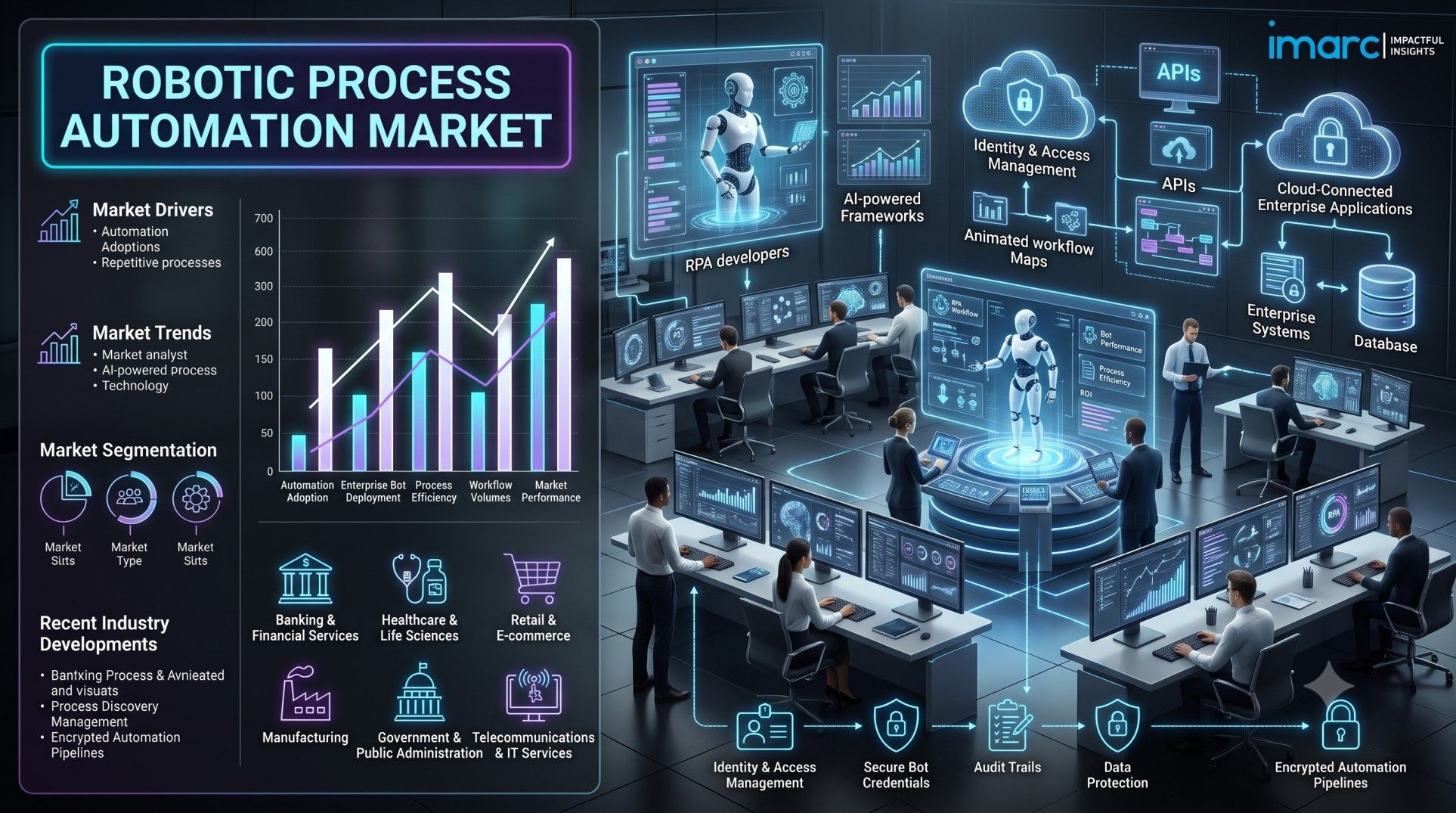
IMARC Group, a leading global market research and management consulting firm, has published its latest market intelligence report on the Robotic Process Automation Market. The global robotic process automation market size reached USD 6.3 Billion in 2025. Looking forward, IMARC Group expects the market to reach USD 42.7 Billion by 2034, exhibiting a growth rate (CAGR) of 22.94% during 2026-2034, driven by rising demand for operational efficiency, cost reduction and enhanced accuracy in repetitive tasks, accelerating digital transformation initiatives, and the deepening integration of artificial intelligence into automation platforms.
Enterprises across BFSI, healthcare, retail, IT and telecommunications are moving beyond simple rule based bots toward systems that can reason, plan and execute multi step workflows. This shift is being driven by growing pressure to cut operating costs, close talent gaps in repetitive back office functions, and respond faster to customer and regulatory demands. RPA is no longer viewed as a standalone tool. It is increasingly positioned as the execution layer beneath broader enterprise AI strategies, working alongside large language models and agentic orchestration platforms to manage data, trigger transactions and maintain compliance across complex, multi application environments.
Robotic Process Automation Market at a Glance
- Market Size: USD 6.3 Billion
- Market Forecast: USD 42.7 Billion
- Growth Rate 2026-2034: CAGR of 22.94%
- Leading Component Segment: Software, given its central role in building, deploying and managing digital workers
- Leading Deployment Model: Cloud based deployment, favored for scalability and lower upfront investment
- Leading End User: BFSI, owing to high volumes of repetitive, rule bound transaction processing
- Dominant Region: Asia Pacific, supported by rapid enterprise digitization and expanding IT services hubs
How AI is Reshaping the Future of the Robotic Process Automation Market
- Agentic Orchestration Replaces Task Level Bots: Vendors are shifting from single task automation toward orchestration layers that coordinate multiple AI agents, human workers and traditional bots within one governed workflow, reducing handoff errors across departments.
- Reasoning Engines Enable Judgment Based Automation: Process reasoning engines now allow bots to interpret unstructured data and make context aware decisions rather than following rigid scripts, extending automation into judgment heavy processes such as claims adjudication and underwriting.
- Enterprise Grade Governance Becomes a Deal Maker: Built in observability dashboards and audit trails are becoming standard requirements for compliance and risk teams before agentic automation is approved for production use in regulated industries.
Grab a sample PDF of this report: https://www.imarcgroup.com/robotic-process-automation-market/requestsample
Robotic Process Automation Market Trends and Drivers
Operational efficiency remains the core demand driver for RPA adoption. Organizations continue to automate data entry, invoice processing and report generation to cut processing time and reduce human error, freeing employees for higher value analytical work. This has a direct financial impact: RPA vendor UiPath reported fourth quarter revenue of USD 481 million, up 14 percent year over year, with annual recurring revenue reaching USD 1.853 billion, reflecting sustained enterprise spending on automation platforms even amid broader macroeconomic caution.
A structural differentiator shaping the market globally is the push toward standardized, interoperable AI systems. Global standards bodies such as ISO and IEC continue to develop frameworks for AI system governance and risk management, while cross industry coalitions are forming around open protocols for agent interoperability, a trend that mirrors the World Trade Organization's broader emphasis on digital trade facilitation and cross border data flow standards for automated services.
This growing emphasis on governed, standards aligned automation is also setting the stage for tighter regulatory and trade oversight, particularly as RPA platforms increasingly touch financial transactions, healthcare records and cross border data processing.
Global Regulatory, Trade, and Sustainability Landscape Shaping Demand
- ISO/IEC AI Management Standards: International standards bodies continue to expand guidance on AI system governance, risk management and auditability, shaping how enterprises validate RPA platforms with embedded AI reasoning before regulated deployment.
- WTO Digital Trade Commentary: Ongoing discussions on cross border data flow and digital services facilitation are influencing how multinational enterprises deploy cloud based RPA across jurisdictions with differing data residency requirements.
- EU AI Continent Action Plan: The European Commission's plan aims to mobilize up to EUR 200 billion in AI investment and stand up at least 13 AI Factories, directly supporting enterprise scale deployment of automation and agentic AI tools.
- Data Residency and Sovereignty Requirements: A rising number of jurisdictions are mandating that automated processing of financial and health data occur on sovereign or regionally hosted infrastructure, pushing RPA vendors to expand regional cloud footprints.
Key Government Schemes and Policy Programs Supporting the Industry
- India, Production Linked Incentive Scheme 2.0 for IT Hardware: Approved with an outlay of INR 62,500 crore over five years to expand domestic electronics and IT hardware manufacturing, the scheme sits alongside the IndiaAI Mission, which has seen its budget allocation rise from roughly INR 19 crore to INR 800 crore, both indirectly strengthening the domestic infrastructure base that supports enterprise automation and AI adoption.
- United States, Technology Modernization Fund: Administered by the General Services Administration, the fund favors AI and process automation proposals with budgets under USD 6 million and fast tracked review timelines, having received USD 225 million through appropriations plus USD 1 billion through a 2021 stimulus law to accelerate government wide automation adoption.
- European Union, Digital Europe Programme AI Continent Calls: The programme's current open call, AI Piloting round 10, carries a EUR 17.5 million budget across grants of EUR 2 million to EUR 5 million per project at 50 to 75 percent funding rates for mature AI deployment projects, part of a roughly EUR 8.1 billion digital fund.
- India, Semicon India Programme: Budget allocation for the scheme rose sharply from INR 638 crore to INR 8,000 crore in the latest union budget cycle, an increase of 86 percent, reinforcing the semiconductor and hardware base underpinning enterprise automation infrastructure.
Robotic Process Automation Industry Segmentation
Breakup by Component:
- Software
- Services
Breakup by Operation:
- Rule based
- Knowledge based
Breakup by Deployment Model:
- On premises
- Cloud based
The cloud based segment leads deployment as enterprises favor lower upfront costs, faster scalability and easier integration with existing SaaS ecosystems compared to on premises installations.
Breakup by Organization Size:
- Large Enterprises
- Small and Medium Sized Enterprises
Breakup by End User:
- BFSI
- Healthcare and Pharmaceuticals
- Retail and Consumer Goods
- IT and Telecommunication
- Government and Defense
- Transportation and Logistics
- Energy and Utilities
- Others
BFSI leads end user adoption given the sector's heavy reliance on high volume, rule bound processes such as account reconciliation, KYC checks and claims processing, all of which are well suited to automation.
Breakup by Region:
- North America: United States, Canada
- Asia Pacific: China, Japan, India, South Korea, Australia, Indonesia, Others
- Europe: Germany, France, United Kingdom, Italy, Spain, Russia, Others
- Latin America: Brazil, Mexico, Others
- Middle East and Africa
Competitive Landscape
The market features a mix of established enterprise automation vendors and AI native challengers. Key players include Amelia US LLC, Automation Anywhere Inc., AutomationEdge, Blue Prism Group PLC, Infosys Limited, International Business Machines Corporation, Kofax Inc., NICE Ltd., Pegasystems Inc., UiPath, Verint Systems and WorkFusion Inc.
UiPath reported full year fiscal 2026 annual recurring revenue of USD 1.853 billion, up 11 percent year over year, with a dollar based net retention rate of 107 percent, reflecting continued expansion within its existing customer base as clients scale automation beyond initial pilot deployments. IBM, meanwhile, brought its watsonx Orchestrate platform to full general availability with more than 150 enterprise connectors spanning Salesforce, SAP, Workday and AWS, underscoring how legacy technology vendors are repositioning around agentic orchestration to compete directly with dedicated RPA players.
Market Concentration Analysis
- Consolidation Around Agentic Capabilities: UiPath's acquisition of fellow report listed vendor WorkFusion signals active consolidation among established RPA players seeking to add specialized AI agent capabilities rather than build them from scratch.
- Diversified Field at the Challenger Tier: Automation Anywhere's acquisition of Aisera alongside reported merger discussions with C3.ai point to further reshuffling among mid tier and AI native entrants competing for enterprise agentic automation budgets.
- Platform Vendors Entering From the Top: Large horizontal technology vendors such as IBM are entering the competitive set through orchestration layers rather than traditional bot development, adding a new axis of competition beyond the historically RPA focused vendor list.
What Does The Full Report Cover?
- Historical performance and structural growth trajectory of the global robotic process automation market
- Detailed breakup by component, operation, deployment model, organization size and end user
- Regional and country level analysis across North America, Asia Pacific, Europe, Latin America, and the Middle East and Africa
- Key market drivers, restraints, opportunities and emerging trends
- Value chain analysis across the robotic process automation industry
- Competitive landscape including detailed profiles of major companies
- Strategic recommendations for market entry and expansion
Note: If you require specific details, data, or insights that are not currently included in the scope of this report, we are happy to accommodate your request. As part of our customization service, we will gather and provide the additional information you need, tailored to your specific requirements. Please let us know your exact needs, and we will ensure the report is updated accordingly to meet your expectations.
Key Questions This Report Answers
- What is the current size and growth trajectory of the global robotic process automation market?
- Which component, software or services, holds the largest market share?
- How is deployment model preference shifting between on premises and cloud based RPA?
- Which end user industry is driving the highest adoption of automation platforms?
- Which region currently leads the global robotic process automation market?
- Who are the key players and how concentrated is the competitive landscape?
- How is agentic AI reshaping product strategy among leading RPA vendors?
About Us
IMARC Group is a global management consulting firm that helps the world's most ambitious changemakers to create a lasting impact. The company provides a comprehensive suite of market entry and expansion services. IMARC offerings include thorough market assessment, feasibility studies, company incorporation assistance, factory setup support, regulatory approvals and licensing navigation, branding, marketing and sales strategies, competitive landscape and benchmarking analyses, pricing and cost research, and procurement research.
Media and Sales Contact
IMARC Group
Email: [email protected]
United States: +1-201-971-6302
India: +91-120-433-0800
United Kingdom: +44-753-714-6104